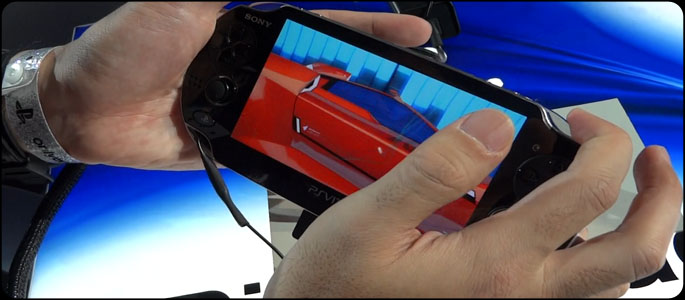
I’m in an interesting situation where I was able to snag a Vita from a Japanese game shop on the 17th (16th to you North Americans), but the very next day, I had a long series of flights back to North America for Christmas vacation. While I haven’t yet done enough gaming to bust out full reviews of anything, I do have some impressions of the system itself and the three games I came away with. We’ll start with the software.
RIDGE RACER
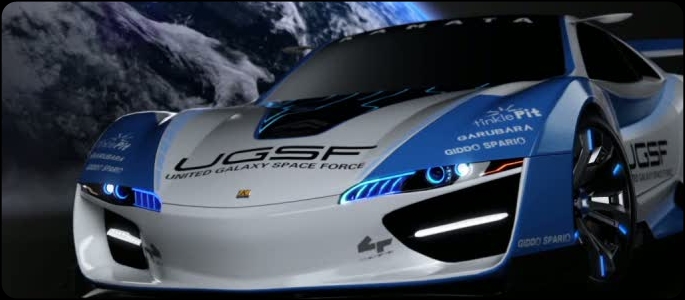
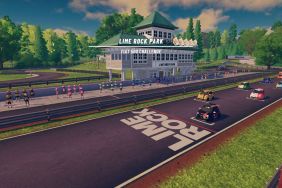
The Vita’s entry into the Ridge Racer series takes an experimental step in what could very well become a popular move by developers. Right out of the box, the game has very little content, offering players a skimpy three tracks and five cars. The idea is that there will soon be a steady flow of downloadable upgrades of both free and paid variety. The game is the cheapest physical title of the Vita’s whole lineup so far, going for a recommended 3,990 yen instead of 6,080. Clearly, the idea is that clearly gamers can pay for however little or much content they want. I have often wanted this for online shooters, because I am one of about eight people worldwide who does not play shooters online. Sell them for $25 or $30, but then charge another $25 if you want to play it online. Awesome if you’re me, but you online multiplayer kids would probably freak out at the idea of someone paying less than you.
Where the game hits a rough patch is that, in order to start, you have to connect to the internet and create a profile, which I didn’t know when I purchased it. Sure, I expected a focus on the online features, the sharing, the trophy stuff and all that new-age hooplah, but I was unaware that the game in no way allows players to play without first connecting to the internet. I found this out at a bad time, as I bought it with the intention of playing it on a long plane ride. Oops. If I had created my profile at home, this could have been avoided, but with 16 hours in the air and 10 hours of layovers, I thought I had enough time on my hands to address any problem. But even though three of the four airports I would stop at offered free WiFi, you know how that goes at airports; you get the splash page, the terms of service and all that good stuff. Without jumping through airport hoops, you can’t connect. The Vita instinctively tried to connect to the network, but without being able to access the splash page and such, it gives only errors. Jumping from the game to the browser is not an option, because doing so closes the game. This scenario might just be a great case for the 3G Vita, which could obviously connect without being subject to WiFi networks, but my Japanese unit wasn’t gonna be connecting to DoCoMo from the states.
HOT SHOTS GOLF: WORLD INVITATIONAL
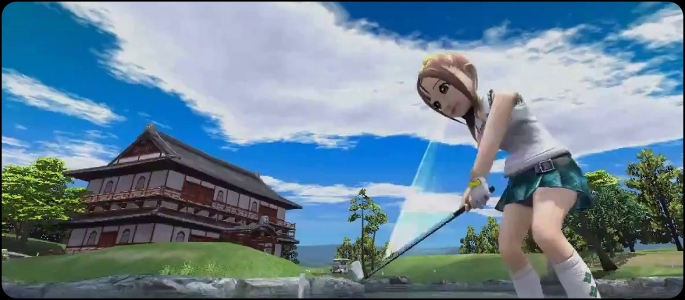
I didn’t realize how much I missed Hot Shots Golf until firing this up. From the original PlayStation days up through the PSP games, I’ve enjoyed this series even though I admittedly tend to forget that it exists. I go through a cycle of falling in love, forgetting about it, then falling in love again. Of the three I bought (well, two that I played), this one best shows off the Vita’s visuals. The imagery is constantly sharp and colorful, definitely the best-looking HSG game to date, though the series of course is not about visuals.
Players of previous games will feel instantly at home with this one; you know what you’re getting into. For the sake of my long trip, it thankfully isn’t bound exclusively to online play. There are, however, many features that take advantage of the Vita’s much-publicized online friendliness. Due to the same hiccups Ridge Racer had, I haven’t yet been able to play online or check the leader boards, but it seems like doing so will be pretty neat. Even single player just with though, I’ve been having a lot of fun with this.
SHINOBIDO 2
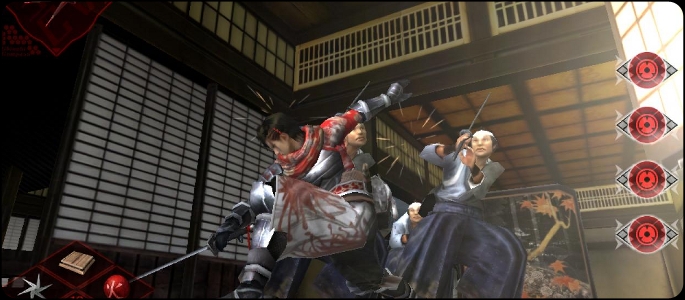
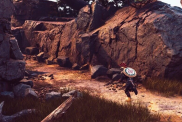
Due to how awesomely fun the golf has been, I haven’t put as much time into this one as I expected to, but I’ve completed around five missions (some multiple times to get better grades and more practice) and I can tell this game has some potential to really be a fun ride. This looks and feels a lot like the popular ninja stealth series Tenchu, which makes it no surprise that it’s by the same developer. Players start out with a story-based introduction and are put into some tutorials, each focusing on a different aspect of what is winding up to be a pretty complex game overall. The first mission, for example, starts by just showing you how to use the camera and making sure you can manage running from point A to point B, then you move on to trying to make your first stealth kill.
Those are some of the biggest things that remind me of Tenchu. Who among us didn’t love sneaking up behind someone and carefully delivering that fatal blow, often with rad animations and gallons of blood as our reward? People who didn’t play Tenchu, that’s who. Go dig up the first game for PSOne or Wrath of Heaven for PS2. Don’t bother with the others. This looks like a must-have for fans of that series or those who just dig ninja stuff, so it’s good news that the game is being localized.
Note: The following impressions are contributed by Anthony Severino.
LITTLE DEVIANTS
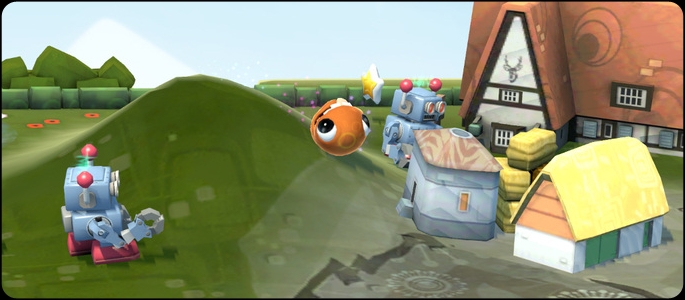
Little Deviants is that game used during the “NGP”’s debut to show off the unique rear-touch screen. You know, the one that you touch the back and the once flat ground turns into a mountain, steering a little ball of deviant around a course? There’s more to Little Deviants than just that, but it’s not a meaty game, either. Rather, it’s a host of mini-games, all taking advantage of the PlayStation Vita’s unique functionality.
These cutesy Little Deviants come in a variety of shapes, sizes and colors. Different Deviants have different games, but they’re all a “little” light on content. What is there is fun, but can get old quickly. If only I could read Japanese, I could probably get more out of my experience here with Little Deviants.
UNCHARTED: GOLDEN ABYSS
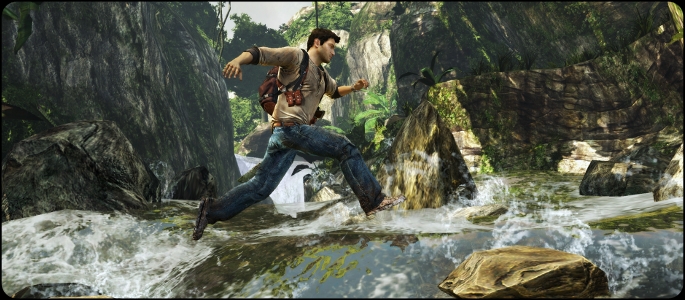
This is the launch title to pick up with your PlayStation Vita. It’s a blockbuster game through and through. The graphics, the gameplay, everything – it’s more console experience than any other portable game I’ve ever played.
Nathan Drake has more tricks up his sleeve than he does on his PS3 counterpart, mainly thanks to the PlayStation Vita’s touch-screen and rear panel, as well as the built-in camera. Puzzles, obstacles, melee and more all use the touch screen, but it’s far more than just a gimmick.
We just came across a part in the game where there’s a blank piece of parchment. To reveal the hidden writing, you have to hold the back of the PlayStation Vita to an actual light source (a light bulb will do) for the scripture to appear. I was actually in shock that ideas like that are already being explored in a launch game – imagine what developers will cook up in the future.
Our full review should be ready by tomorrow, but we’ll spoil it a little for you: It’s the most full-featured portable game ever, and is the reason to own a PlayStation Vita.
Both myself and Anthony will have full reviews of each game coming out as we finish them. As always, stick with the LifeStyle for more impressions of PS Vita hardware and software in the near future.